Sounds like pretty sound advice, but as usual, we in the west are doing just that. Not that there isn't good reason to be preoccupied with other matters. Seems these days the volume has been turned up a notch on the global crisis amplifier from the natural, financial and political spheres. Volcanoes, oil spills and floods threaten to destroy the world or at the very least disrupt our lifestyles; the menace from the contagion of crumbling debt ponzi-schemes has moved from companies and global capital markets to nations and continents; meanwhile those very markets are determining who will ultimately govern nations, making ascots cool again while taking wild 1000 point 20 minute drops only to bounce back. So, it's with with little hope of exciting curiosity that I'll try to shift your gaze for a moment to the dancing bear of the east, Russia. Almost a couple of years on from the Georgian adventure, Moscow has returned to the quiet reordering of what it considers its sphere of influence.
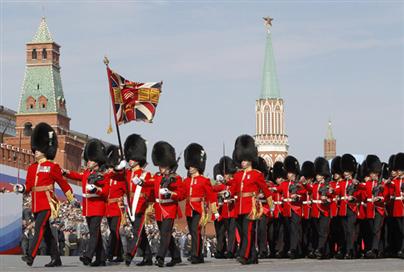 We're not going back to the USSR mind you seeing as NATO soldiers marched on Red Square last weekend to commemorate the Russian (or USSR) victory in WWII, the Victory Day parade. Most of the west has their ideas about the end of that war, the Russians their own that gave them the right to dominate Eastern Europe for half a century. Hu Jintao of China and German Chancellor Angela Merkel watched as over 11,000 troops marched, planes zipped while tanks and missiles rolled by. Medvedev had to defend inviting serving US, British, French and, you guessed it, Polish troops to some skeptics, particularly the communist remnants of the country. While the wild stories about the Russians being responsible for Kaczynski's plane crash last month seem to be just that, wild yet plausible stories, you never forget the communist past in this part of the world. Yet neither do they in America, where they're still hunting Commies too while the geopolitical map is being redrawn for them.
 The signing of the Black Sea rent deal last week between Russia and the Ukraine re-cemented more than the bond they feel sharing Victory Day along with Belarus and other former Soviet countries a day later than Western Europe. As the German Instrument of Surrender was signed at 23:01CET, the west celebrates on the May 8th, while being well after midnight Moscow time, they celebrate on the 9th. The Ukrainian parliament may have had a screaming argument to pass the new lease which allows the Russian Black Sea fleet to be based in Sebastapol, but it slipped by unnoticed by most of the MSM. The Russian fleet's rental agreement had been due to expire in 2017, but has now been renewed for 20 years in exchange for cheaper gas, from $330 to 230/1000 cubic meters, about 30% off. Rent to keep the Black Sea fleet at Sevastapol had been $98 million per year, while the Ukrainians had complained it was worth between one and two billion annually. Cheap gas for docking rights is one thing, but the bear is now looking to swallow the entire distribution network, with Russia's Gazprom absorbing the Ukrainian Naftogaz. With 80% of Russian gas to the EU flowing through the Ukraine, much of the continent would be even further at the mercy of Moscow. Not everyone was happy with the agreement, as eggs and smoke bombs were thrown during the ratification in parliament. Ukrainian democracy in action thanks to the February presidential election which saw a Russian favourite re-installed as Victor Yanukovich won out over Orange Revolution darling ex-Prime Minister Yulia Tymoshenko and now ex-president Viktor Yushchenko who managed to garner 5% of the vote. Seems the new Russian warmth also includes shifting the press and the official stance of the nation to forget about the past, or at least move towards the bad old days of lies and obfuscation of subjects such as Holodomor; moving away from terms like genocide toward the more blameless painful 'restructuring'.
Eight and a half million of the 27 million Soviets killed during the Second World War were soldiers while between three and ten million Ukrainian civilians died in the mass starvation known as Holodomor. Sure, there's a bit (read: a lot) of an unknowable factor in the equation, namely, was it just the Stalinist policies that were responsible for those starvations or a direct order from Josef himself - the fact is it was a lot of death thanks to Russian, um, Soviet domination. Yankukovich's first move as president was to remove the section dedicated to Holomodor on the Presidential website. In a speech to the Council of Europe (who do call the event genocide) the new and improved Victor said he considered the famine "a shared tragedy" of all the people who were all part of the Soviet Union. Potato, potahto - genocide, herbicide, that's what big powerful neighbors are for, to shift the burden of guilt I suppose. Oh yeah, and ruining the idea of communism and therefore socialism forever, cocksuckers.
Living here in Poland it's not too hard to feel those same effects. It's not just the neoliberal attitude of the people, but the common fear of Russia. Can't blame them either. I mean, Poland was wiped off the map for 123 years thanks in most part to that damn Catherine, the Great One. It was a kick in the nuts to give the Poles about 30 years of inter-war independence before the next big war saw them practically wiped off the map only to be handed back to Moscow once again. The only wonder then is that there aren't more conspiracy stories flying around following the Polish presidential plane crash on the way to the site of yet another Stalin era massacre, Katyn. Oh yeah, there are elections coming here next month that could see Lech Kaczynski replaced by his brother Jaroslaw, but that's a story for another day.
 While I don't understand the allegiance Poland feels to the western powers after being left to the Soviets after WWII, it's easy to understand their distrust of their neighbors, well the Kaliningrad bit at least. Experience has taught the Poles that Pan-Slavism is simply code for Russification, where Rus dominates little Lech and Czech, which has helped NATO become strongly entrenched here, a fact the F-16s flying out from just north of where I live remind me on a daily basis. I still catch myself looking up as they fly by while the locals don't even notice. Eastern NATO encroachment, which seemed an unstoppable force just a few years ago, is something the Russians have put off indefinitely in Georgia and the Ukraine, both critical geopolitical hinges, the Caucasus and the Black Sea. Meanwhile, it seems Hillary's pressing of the reset button for the Obama administration in US relations with Russia after they stepped on the Georgian rose, didn't prevent the Kremlin from poisoning the tulip. Along with the squeezed orange in the Ukraine, it seems the colour/flower-coded American created revolution victories of the early zeros have been for not. Nation building in Afghanistan, especially with the upcoming Kandahar offensive, could become even tougher if the airbase north of the Kyrgyz capital of Bishkek becomes unavailable to the Americans.
 Considering how crucial the US airbase in Manas is in the supply chain to keep the war machine killing brown people in Afghanistan having moved 50,000 coalition forces into the war zone in March alone, it's amazing how little news is coming out of the Central Asian country. Sure, the airbase is once again operational, but the rental agreement is feeling even less firm than the beginning of April, before the coup. You see not only is Kyrgyzstan the lone country in the world to maintain daylight saving time all year, it's also the only country in the world to be hosting both a Russian and US airbase! The Russians were quick to throw their support behind the new government, having tired of former president Bakiyev's antics. After saying he'd evict the American base in exchange for writing off $180 million in debt, a $2 billion loan, subsidies and $150 million in direct aid from Moscow, he then changed his mind when the US agreed to triple the Manas base rent last June and rename the facility a 'Transit Center'. Hmmm, could all this cash be what convinced Bakiyev to get out while he could taking up to $200 million with him? Well, the US lease was set to run out in July again, but an announcement saying it will be automatically renewed was issued, so we may have to wait awhile to find out how much the new leaders will cost.
Last Sunday was also Mother's Day in parts of the world including the US where Sarah Palin tweeted: "U.S. Moms: we are thankful 4 freedom! Despicable treatment of women in Iran(setting U.N.policy on women’s rights)make U.N.credibility a joke". So thoughtful. Yeah freedom. Boo Iran. Yeah US moms. Boo UN. At least it's better than listening to her voice plus her populist propaganda did serve to remind me to mention Russia's hole card in the present geopolitical deal where the ace of spades in the deck has the unmistakable shape of a warhead. From the beginning of his candidacy through two speeches in Prague almost exactly a year apart it's been made clear that the centerpiece of the Obama administration's foreign policy is a nuclear weapons-free world. While the flurry of activity regarding this noble cause has been impressive, it's clear that the main goal isn't to rid the world of nuclear arms, but to make sure regime's America doesn't like don't get hold of them. Well, not counting North Korea. It doesn't take a genius to see that today this means one country, Iran, and being the other major nuclear power, Russia again has a huge role to play as together they hold 95% of the world's nuclear weapons. In rapid succession we've seen: the release of the US Nuclear Policy Review defining both the number of ready nuclear arsenal (5113 functioning, around 4500 retired) and posture, or who they would attack; the signing of a new START Treaty which committed the US and Russia to a 30% reduction in the number of deployed strategic warheads; a two-day Nuclear Security Summit in Washington of 47 world leaders that saw a pledge to secure the world's stockpiles of plutonium and highly enriched uranium; the revival of the US-Russian civilian nuclear deal; and the ongoing month-long review of the Nuclear Non-Proliferation Treaty (NPT). Unsurprisingly, it's all been smoke and mirrors.
The new US policy rules out using nukes on non-nuclear powers - as long as they abide by treaty obligations - specifically pointing out Iran as a potential target. Worried about this and not being invited to the security summit, Iran had it's own meeting called "Nuclear Energy for all, Nuclear Weapons for none". All this was capped off by the childish behavior of the UN delegates walking out on Ahmadinejad's speech at the start of the NPT review last week. The month-long NPT review conference began inauspiciously as the delegates from the US, Britain, France, Canada, Hungary, New Zealand and the Netherlands walked out on the opening speech of Iranian President Mahmoud Ahmadinejad. Oops, sorry, that link was when they walked out last year, here they are walking out, oops, last year again, here's last week. Guess the only country in the world to have used nuclear weapons on their enemy don't like to hear that the bargain struck by the treaty they are trying to improve which came into effect in 1970 was that non-nuclear states would refrain from building weapons so long as those that already had them would make credible moves toward disarmament. All this activity has served to show that it won't occur overnight, the changes are gradual rather than transformational, after all, many Americans actually prefer president who wants to use nuclear weapons, not waste them.
Energy price hikes were enough to spark the coup in Bishkek, but in Tehran the green revolution couldn't bring down the regime as they're sitting on so much gas, oh, and that little nuclear power plant the Russians are helping to finish. Meanwhile, America is stamping her feet, trying to get Russia (and even less likely, China) on board to support a fourth round of sanctions against Iran for their supposed nuclear weapons program. Never mind that this program is yet another of the fires that the US itself set in the past only to have the shifting winds of time blow it back on her face. Blowback, the Russians are pretty good at that too, did we get into the Turkish or Syrian nuclear power plants they're now going to build? Back when the Shah was running things, the US in fact helped start the program it now wishes to see shut down. Thanks to the US and her allies, particularly the West Germans, we've had 30 years of scaremongering about Iran's pursuit of the bomb. In the meantime, Russia agreed as far back as 1995 to help the Iranians complete a power station in Bashehr that was started when there was still a West Germany, who were paid for work never completed.
In a similarly embarrassing reminder of the curtailed power wielded by Washington to the Israeli announcement of plans to build housing in East Jerusalem during Vice President Biden's visit there, the Russians announced that the Bashehr nuclear power plant would be completed this August during Secretary of State Hillary Clinton's visit to Moscow in March. While this affront may not have derailed the successful completion of talks to replace the START treaty, it does signal that Russia may not be ready to back UN sanctions against Iran. Even more awkwardly for America, as highlighted by Egypt's proposal for a nuclear weapons free zone in the Middle East, is the fact that Washington's closest ally in the region is probably sitting on a couple hundred warheads and aren't even participating in the NPT conference as they along with India and Pakistan never even signed the original agreement. Weapons of Mass Disruption, heh, heh. They have no plans of signing anytime soon either. Little known fact of the day learned while writing this - Israel helped the South Africans build their bombs.
 Yikes, that's what happens you start watching dancing bears, we we're talking about Russia weren't we? It's not like the US are the only ones with problems, Russia has their share. Chechnya has been replace by other North Caucasus republics of Dagestan and Ingushetia. As we near the ten year anniversary of the regions first suicide attack in Chechnya June 7, 2000, there's no sign of peace in site for the region. Two wars in Chechnya only served to spread the violence beyond its borders, spawning stories of Black Widows along with untold misery and slaughter. Terrorist bombs blow below journalists and activists being gunned down while oligarchs remain indefinitely on trial. Oh yeah, we didn't even get into the China angle, after all they've got a few nukes too and their volatile Xinjian province, home of the Uighur minority, is a mere 200 miles from Manas and feel a little uncomfortable with US encirclement when combined with their cooperation with Taiwan, Japan and India. Did I mention they've also got a few (two or four) new nuclear subs to play with and are winning the game anyway? Or that the leaders of Kazakhstan and Uzbekistan are both in their 70s and in dubious health having between them five daughters and not one son (well, Kazakh President Nursultan Nazarbayev reportedly has a son from his third wife). Oh boy, don't they know we've got enough on our plates to worry about some silly bear playing with energy strings, nuclear weapons and naval ports. Give them a puck, now that's more like it.


 Posts
Posts