Tuesday, May 25, 2010

Colombia's Green Revolution

"In a society where human life has lost value there cannot be any other priority than re-establishing respect for life as the main duty of citizens."
- Colombian presidential candidate Antanas Mockus
These are dark days in the world of politics. A replay of the Thatcher/Reagan tidal wave that drowned progress 30 years ago seems inevitable as the rightwing spin on the causes of the latest financial crisis seems to be gaining the upper hand. Once again, the UK is leading the way, ConDem'd by a lethal combination of a spiraling debt and a new government intent on reasserting the supremacy of the elite. In America, the Tea Party has become more than a cover for the sexually repressed teabagging of last spring and is now powerful enough to dictate who will run in many of November's mid-term elections. Meanwhile, continental Europe has decided the best way to save their currency is to print a trillion euros to hand over to the banks. Oh, and not fix anything besides cutting the benefits of those who will have to pay the money back. Fortunately, there seems to be one place where they've realized that when something no longer works, it's time to try something different. The May 30th Colombian presidential election may see the election of the world's first Green president.

It seemed a few months ago that Álvaro Uribe would be able to pull off the African dictator-for-life trick of changing the constitution to remain president, after all, he did it in 2006 to the delight of multinational corporations, the rich and paramilitary death squads. Miraculously, the supreme court ruled against his bid, yet it seemed even that wouldn't stop his policies from being continued as the initial favourite to win was Uribe's replacement candidate for the Party of National Unity, known as the Party of the U, former defense minister Juan Manuel Santos. After all, Uribe won reelection in a landslide and with the continued support of the wingnuts pumping up the Hugo Chavez rhetoric only a superhero would be able to derail the status quo from further entrenching the might is right lunacy that ensures the perpetuation of hate and death.

There seemed to be no less likely candidate for national superhero in 1993 than Antanas Mockus. After studying mathematics in France he returned home to study philosophy. This son of Lithuanian immigrants has shown his flair for the unexpected and unpredictable, he and his wife took their wedding vows while astride an elephant inside a cage full of Bengali tigers. Yet he also served as vice-president and then president of the National University of Colombia and contributed to the formulation of the Colombian Constitution of 1991. But it was his eccentricity that launched his political career and marked the turning point for Bogota, at the time on of the most dangerous cities in the world. It was the early 90's, the university campus was in chaos thanks to anarchists and FARC rebels. Invited to speak before students, Mockus, a pacifist, had vowed not to be humiliated but was pushed to the limits of his patience as students booed and heckled. Suddenly, in the moment that changed everything, he undid his belt, turned, and mooned the audience. For whatever reason, his university, his city and perhaps in the future, his country, would never be the same again, as he was forced to resign and found himself swept into the mayor's office on a wave of public support. A born teacher, he changed everything by teaching the people how to live in society, from respect to conservation.

The best way to keep the military and her American arms suppliers happy though is to maintain the status quo. That means the Pablo Escobar image of Colombia as a dangerous place that produces cocaine and rebels and therefore needs to be ruled with an iron fist. Now in its tenth year, Plan Colombia, originally scheduled for two years, has seen the US pouring money into the country, sending more there than the rest of Latin America put together. Álvaro Uribe has presided over Colombia's continued capture by American foreign policy which has meant a staggering spike in inequality. Drug lords and arms dealers are part and parcel with subsistence farmers who don't even know who Mockus is as the live without TV's. Last summer the Colombians agreed to give the US what the MSM labeled narcotic and inusurgent aid but is simply cover for a dirty drug war that spawns FARCs and wacky neighbors like Hugo. Of course Chavez railed against the plan, but there were also reasonably sane leaders who opposed giving the Americans an increased free hand in the airspace of the region at the meeting of the Union of South American nations such as Argentina's Kirchener and Ecuador's Rafael Correa. Oh, and Brazil's Luiz Inácio Lula da Silva, the guy who just struck a deal to partially solve the Iranian impasse, so good in fact the US had to move quick to emaciate it. Sovereignty was maintained per the letter of the accord, but the US was in fact given expanded access to airbases, an exception to the trend of losing friends and bases, Ecuador's Manta airbase joined the Central Asian losses. A 10-year lease gave the US access to seven Colombian bases - three air force, two naval and two army – stretching from the Pacific to the Caribbean. The 800 American soldier cap was maintained as well, but with private armies outnumbering government troops in most warzones these days, the 600 contractor clause seems to have little relevance.

Hey it's just a drug war, after all about 90 percent of the cocaine produced in Colombia is smuggled into the United States, despite more than $6 billion of American security aid to Colombia over the last decade to combat insurgents and trafficking. Oops more MSM lingo. The now 46-year old conflict needs to be brought to a close, it makes the Afghanistan war look short. It's not about Chavez though the wingnuts like president Uribe (oh yes, I'm afraid Álvaro is one, fits my classic definition of one who perpetuates ideas that don't work) would have us think by saying things like, "On various occasions Mr. Chávez has said that at any moment he’d turn on his Sukhois and in a few minutes they are in Colombia". In fact Venezuela remains Colombia's second biggest trading partner. Though yes, the Russians are keeping Venezuela's armed forces looking good.

Bolivia's president, Evo Morales, called for a continent-wide referendum on the plan, saying "If the Colombian president wants his bases to be used, I say I want a referendum in South America so the people of Bolivia, Colombia, Peru, Venezuela, Brazil, Argentina all 12 countries can decide." You see this came hard on the heels of the Colombian armed forces almost provoking a regional war by crossing into Ecuador and killing the Farc second in command. "Alias Raul Reyes has been killed in combat," a beaming then defense minister now presidential hopeful, Juan Manuel Santos, announced at a press conference in March 2008. Raul Reyes, whose real name was Luis Edgar Devia Silva, was the first member of the secretariat of the Revolutionary Armed Forces of Colombia, (Farc) to be killed in combat with Colombian government troops in the four-decade-old history of the rebel army. As spokesman and leader of the political wing of the guerrillas Reyes was believed to be first in line to take over from legendary Farc leader Manuel Marulanda. Sixteen other rebels and one solder died in the raid, Santos said.

Based on what the two-time mayor of Bogota Antanas Mockus did over his terms, he would do things differently than the former defense minister's promised continuation of Uribe's policies. Reyes was the Farc's top negotiator during failed peace talks with the government of Andres Pastrana from 1998 to 2002, during which he led a Farc commission on a tour of several European nations. The death of Reyes came two days after the Farc unilaterally released four civilian hostages who had been held for more than six years in jungle camps. Mediators working for the liberation of those and dozens of other hostages had met with Reyes to negotiate their release. Mockus condemned such an aggression into a neighbour's soil and said he wouldn't do it.

His wacky style led to landslide victories and um, creative solutions to problems. The list of achievement by Mockus during his time as mayor read like the magical realism quality of a novel by compatriot Gabriel Garcia Marquez:
  • he helped solve a water shortage by appearing on TV showering, showing Bogotanos how he turns off the water while soaping up - within two months a 14% reduction in water usage had been achieved
  • he asked the city's richest residents to pay an optional 10% tax and more than 60,000 volunteered to pay helping the city triple it's 2002 tax revenue from 1990
  • taming traffic turmoil by deploying teams of street mimes to show both drivers and pedestrians how to behave, so successfully he was able to dispense with the corrupt municipal traffic police and employ more mimes instead
  • in an effort to reverse aggression and violence in the city, he carried out a massive educational initiative. City government worked with prostitutes, the homeless and prison inmates. Policemen were obliged to attend training in conflict resolution. Children were encouraged to report domestic violence
  • as women were afraid to go out at night and realizing that seeing them in the streets creates a safer atmosphere, he asked men to stay home and reflect on women's role in society. An estimated 700,000 women strolled the newly created pedestrian central boulevard the first night to enjoy open-air concerts and ladies only promotions
  • intent on getting the homicide rate under control and reducing late night fights, Mockus pushed for the so-called "Carrot Law" which obliged bars to close at 1am. (A "carrot" is slang for a healthy person who doesn't smoke or drink.) The homicide rate saw a reduction from 80 per 100,000 in 1993 to 22 in 2003
  • to convince taxi drivers to hand over their guns he allowed them to up their fares while creating a report an honest taxi driver campaign which resulted in 150 of them being dubbed "Knights of the Zebra" to advise the mayors office on taxi 'etiquette'
  • raising awareness by painting stars on the pavement where pedestrians are killed and seeing a reduction in traffic fatalities from 1300 to 600 a year
  • -more initiatives here
Today, Bogotá is a radically different place with 400,000 bicycle users. Car use is down, 1.6 million people travel on the Trasmilenio daily and Bogotá is automobile-free on major streets on Sundays. Traffic fatalities and homicide have been drastically reduced. A whopping 98.5% of kids attend school.

Wait, it gets even cheesier. Mockus encourages his staff to hug each other while the regime that Santos represents establishes the Justice and Peace Law (yeah, I know, how could something with a name like that not be nefarious?). It demobilized many paramilitary members and guerrillas but also granted them de-facto amnesties while allowing the groups to continue their war of terror against the left. No, not only the military left, more importantly, the labour left. Colombia under Uribe has stretched it's commanding lead in the trade unionists murdered charts, the highest clip in the world, every year, teachers to miners. In fact the first close collaborator of the 12 Apostles, a paramilitary group so-named because one of its members is a priest, has just spoken out in Argentina about Uribe's brother Santiago's direct payment to death squad members. At the very least President Álvaro knowingly granted them amnesty back in 2005.

The bizarre quality of the election story was enhanced by the presidential debate question posed by a doll asking, "Little ball, little ball for two hundred. Mr. Candidate how can you help me. I want to study but I have to work." Oh yeah, Mockus was abused as a child and has recently announced that he is in the first stages of Parkinson's Disease. If anything, Antanas seems to have picked up support since he announced that he had the disease on a talk show. The last poll results were announced on Friday, they won't be conducted for the last week as a twist in election law bans them along with campaigning. So, theoretically, Sunday's rallies were the last chance for the candidates to make their pitch. A Mockus victory would give hope that the next stage of Colombia's history will be written in pencil, not with blood. In 25 years, 5 million have been displaced by war ensuring 60 percent of rural Colombians remain poor, according to Ricardo Bonilla, an expert on poverty at Bogota's National University. A country where at least 2742 trade unionists have been murdered since 1986. A place where each of the six banana companies operating pays between 3 and 4 cents for every banana produced directly to support death squads. This helps to ensure that 79% of the Afro-Colombian population has been internally displaced through massacres, killings, threats and intimidation so the companies can move in and use the land. A country that doesn't respect international borders, launching cross-border attacks into foreign territories to achieve military objectives.

Mockus, the philosopher-mathematician of course has a vice-presidential candidate who is a fellow mathematician and ex-mayor of Medellin, Sergio Farjado. He took what was described by Time as the worst city in Colombia and succeeded in reducing crime, cleaning the streets and turning the city into a modern metropolis with a state-of the art metro. The last polls showed Santos in a statistically insignificant lead, around 34-32%, but with neither reaching the 50% threshold, a second round will be needed, one that is polling 45-40% in favour of Mockus as he'll pick up more of the non-incumbent vote. You would vote for change too with a 43% poverty rate as the never-ending war is nothing but an American exported cause of extreme inequality, the only major country in Latin America in which the gap between rich and poor has increased in recent years, according to a report by the U.N. Economic Commission on Latin America. The percentage of Colombians who are indigent also rose from 20.2 percent in 2007 to nearly 23 percent in 2008, nearly double the region's average. Where the power of the state is used to conduct illegal wiretaps on political opponents and journalists. Even more seriously, about 90 members of Congress, most belonging to Uribe's party, are being investigated or are already in jail in conjunction with the "parapolitics" scandal linking government figures to paramilitaries and drug traffickers. Even more seriously, under Santos' watch, the army has developed a body bag culture where success is measured in killed enemy combatants with the inevitable result of a "false positive" scandal. Civilians are rounded up, dressed in rebel uniforms, and turn up dead in the countryside. The attorney general is investigating cases involving over 2,000 victims.

To Uribe supporters in Washington, and to investors the world over, the Colombian government touts its success in delivering blows to a guerrilla movement that once seemed invincible, an effort carried out with $7.3 billion in U.S. aid since 2000. The economy has since flourished, more than doubling output since 2002 when Uribe took office. Foreign investment in Colombia is the fourth-highest in Latin America which ensures the rich receive grants while the poor burden tax and death squad law. That philosophy was crystallized through the Insured Agro Income program, which provided most of a $250 million annual fund to sugar, palm oil and other large agricultural sectors. Even government officials acknowledge that poverty remains widespread in the countryside. Indigent sharecroppers are relegated to the poorest soil, working land without title, while a swath the size of Virginia is in the hands of drug traffickers and corrupt politicians, said Alejandro Reyes, an expert on land and author of a recent book, "Warriors and Peasants: The Plundering of Land in Colombia." Reyes said the Uribe administration places a priority on funneling aid to the biggest farms because the government believes they are best suited to revive the rural economy. "The government thinks that the peasantry are not good producers, that they don't know how to save, how to assimilate technologies," Reyes said.

What Mockus may deliver is a change that sees the legitimacy of law reinstated. Enough of the shrug of the shoulders when human rights are taken away along with the "es que's". Success in pushing rebels into the jungles has come at too great a price in human rights and the message of an outsider who promises to deliver order within the rule of law may carry the day. Give people dignity and they will return it as Antanas has proven works in Bogota. Who's to say if his social experiment on a city will translate to a national stage, especially with so many rebels and vigilantes controlling so much of the countryside, but Colombia deserves to find out from a man whose overwhelming goal is to teach about the sacredness of life.

For the doubters, there's five more parts to convince you:

Wednesday, May 19, 2010

Self-Directing Incentivized Carrots?

Exams coming up, time runs short before the summer hiatus. Format changes coming in preparation for the summer posting dry spell.

The religious belief in capitalism as the foundation of our society has somehow withstood the financial meltdown with the banks controlling the end of the current virtual money cycle, a true empire of debt. We have to change the way we think, fast:


Am I the only one who thinks this dude sounds a bit like Tom Brokaw? I like the part with the beer and cake fun 24 hours of pure, undiluted, autonomy. People really want to do cool stuff, they just need to be given the chance, who knew? Now if we could only figure out how to make sure they have it. Maybe they'd manage to stop the rain, or figure out if the unpronounceable Icelandic volcano is causing the downpour as well as grounding planes. Oh, and explain to me why the people of Iceland are expected to pay back savings lost in their banks by Brits, but they don't have to reimburse airlines and passengers for losses caused by their volcano.

Saturday, May 15, 2010

Never Turn Your Back on a Bear

Sounds like pretty sound advice, but as usual, we in the west are doing just that. Not that there isn't good reason to be preoccupied with other matters. Seems these days the volume has been turned up a notch on the global crisis amplifier from the natural, financial and political spheres. Volcanoes, oil spills and floods threaten to destroy the world or at the very least disrupt our lifestyles; the menace from the contagion of crumbling debt ponzi-schemes has moved from companies and global capital markets to nations and continents; meanwhile those very markets are determining who will ultimately govern nations, making ascots cool again while taking wild 1000 point 20 minute drops only to bounce back. So, it's with with little hope of exciting curiosity that I'll try to shift your gaze for a moment to the dancing bear of the east, Russia. Almost a couple of years on from the Georgian adventure, Moscow has returned to the quiet reordering of what it considers its sphere of influence.

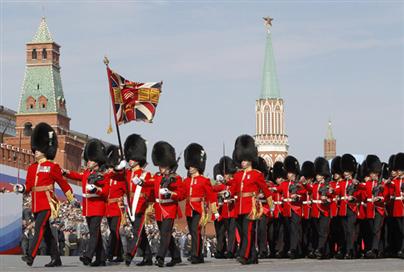
We're not going back to the USSR mind you seeing as NATO soldiers marched on Red Square last weekend to commemorate the Russian (or USSR) victory in WWII, the Victory Day parade. Most of the west has their ideas about the end of that war, the Russians their own that gave them the right to dominate Eastern Europe for half a century. Hu Jintao of China and German Chancellor Angela Merkel watched as over 11,000 troops marched, planes zipped while tanks and missiles rolled by. Medvedev had to defend inviting serving US, British, French and, you guessed it, Polish troops to some skeptics, particularly the communist remnants of the country. While the wild stories about the Russians being responsible for Kaczynski's plane crash last month seem to be just that, wild yet plausible stories, you never forget the communist past in this part of the world. Yet neither do they in America, where they're still hunting Commies too while the geopolitical map is being redrawn for them.

The signing of the Black Sea rent deal last week between Russia and the Ukraine re-cemented more than the bond they feel sharing Victory Day along with Belarus and other former Soviet countries a day later than Western Europe. As the German Instrument of Surrender was signed at 23:01CET, the west celebrates on the May 8th, while being well after midnight Moscow time, they celebrate on the 9th. The Ukrainian parliament may have had a screaming argument to pass the new lease which allows the Russian Black Sea fleet to be based in Sebastapol, but it slipped by unnoticed by most of the MSM. The Russian fleet's rental agreement had been due to expire in 2017, but has now been renewed for 20 years in exchange for cheaper gas, from $330 to 230/1000 cubic meters, about 30% off. Rent to keep the Black Sea fleet at Sevastapol had been $98 million per year, while the Ukrainians had complained it was worth between one and two billion annually. Cheap gas for docking rights is one thing, but the bear is now looking to swallow the entire distribution network, with  Russia's Gazprom absorbing the Ukrainian Naftogaz. With 80% of Russian gas to the EU flowing through the Ukraine, much of the continent would be even further at the mercy of Moscow. Not everyone was happy with the agreement, as eggs and smoke bombs were thrown during the ratification in parliament. Ukrainian democracy in action thanks to the February presidential election which saw a Russian favourite re-installed as Victor Yanukovich won out over Orange Revolution darling ex-Prime Minister Yulia Tymoshenko and now ex-president Viktor Yushchenko who managed to garner 5% of the vote. Seems the new Russian warmth also includes shifting the press and the official stance of the nation to forget about the past, or at least move towards the bad old days of lies and obfuscation of subjects such as Holodomor; moving away from terms like genocide toward the more blameless painful 'restructuring'.

Eight and a half million of the 27 million Soviets killed during the Second World War were soldiers while between three and ten million Ukrainian civilians died in the mass starvation known as Holodomor. Sure, there's a bit (read: a lot) of an unknowable factor in the equation, namely, was it just the Stalinist policies that were responsible for those starvations or a direct order from Josef himself - the fact is it was a lot of death thanks to Russian, um, Soviet domination. Yankukovich's first move as president was to remove the section dedicated to Holomodor on the Presidential website. In a speech to the Council of Europe (who do call the event genocide) the new and improved Victor said he considered the famine "a shared tragedy" of all the people who were all part of the Soviet Union. Potato, potahto - genocide, herbicide, that's what big powerful neighbors are for, to shift the burden of guilt I suppose. Oh yeah, and ruining the idea of communism and therefore socialism forever, cocksuckers.

Living here in Poland it's not too hard to feel those same effects. It's not just the neoliberal attitude of the people, but the common fear of Russia. Can't blame them either. I mean, Poland was wiped off the map for 123 years thanks in most part to that damn Catherine, the Great One. It was a kick in the nuts to give the Poles about 30 years of inter-war independence before the next big war saw them practically wiped off the map only to be handed back to Moscow once again. The only wonder then is that there aren't more conspiracy stories flying around following the Polish presidential plane crash on the way to the site of yet another Stalin era massacre, Katyn. Oh yeah, there are elections coming here next month that could see Lech Kaczynski replaced by his brother Jaroslaw, but that's a story for another day.

While I don't understand the allegiance Poland feels to the western powers after being left to the Soviets after WWII, it's easy to understand their distrust of their neighbors, well the Kaliningrad bit at least. Experience has taught the Poles that Pan-Slavism is simply code for Russification, where Rus dominates little Lech and Czech, which has helped NATO become strongly entrenched here, a fact the F-16s flying out from just north of where I live remind me on a daily basis. I still catch myself looking up as they fly by while the locals don't even notice. Eastern NATO encroachment, which seemed an unstoppable force just a few years ago, is something the Russians have put off indefinitely in Georgia and the Ukraine, both critical geopolitical hinges, the Caucasus and the Black Sea. Meanwhile, it seems Hillary's pressing of the reset button for the Obama administration in US relations with Russia after they stepped on the Georgian rose, didn't prevent the Kremlin from poisoning the tulip. Along with the squeezed orange in the Ukraine, it seems the colour/flower-coded American created revolution victories of the early zeros have been for not. Nation  building in Afghanistan, especially with the upcoming Kandahar offensive, could become even tougher if the airbase north of the Kyrgyz capital of Bishkek becomes unavailable to the Americans.

Considering how crucial the US airbase in Manas is in the supply chain to keep the war machine killing brown people in Afghanistan having moved 50,000 coalition forces into the war zone in March alone, it's amazing how little news is coming out of the Central Asian country. Sure, the airbase is once again operational, but the rental agreement is feeling even less firm than the beginning of April, before the coup. You see not only is Kyrgyzstan the lone country in the world to maintain daylight saving time all year, it's also the only country in the world to be hosting both a Russian and US airbase! The Russians were quick to throw their support behind the new government, having tired of former president Bakiyev's antics. After saying he'd evict the American base in exchange for writing off $180 million in debt, a $2 billion loan, subsidies and $150 million in direct aid from Moscow, he then changed his mind when the US agreed to triple the Manas base rent last June and rename the facility a 'Transit Center'. Hmmm, could all this cash be what convinced Bakiyev to get out while he could taking up to $200 million with him? Well, the US lease was set to run out in July again, but an announcement saying it will be automatically renewed was issued, so we may have to wait awhile to find out how much the new leaders will cost.

Last Sunday was also Mother's Day in parts of the world including the US where Sarah Palin tweeted: "U.S. Moms: we are thankful 4 freedom! Despicable treatment of women in Iran(setting U.N.policy on women’s rights)make U.N.credibility a joke". So thoughtful. Yeah freedom. Boo Iran. Yeah US moms. Boo UN. At least it's better than listening to her voice plus her populist propaganda did serve to remind me to mention Russia's hole card in the present geopolitical deal where the ace of spades in the deck has the unmistakable shape of a warhead. From the beginning of his candidacy through two speeches in Prague almost exactly a year apart it's been made clear that the centerpiece of the Obama administration's foreign policy is a nuclear weapons-free world. While the flurry of activity regarding this noble cause has been impressive, it's clear that the main goal isn't to rid the world of nuclear arms, but to make sure regime's America doesn't like don't get hold of them. Well, not counting North Korea. It doesn't take a genius to see that today this means one country, Iran, and being the other major nuclear power, Russia again has a huge role to play as together they hold 95% of the world's nuclear weapons. In rapid succession we've seen: the release of the US Nuclear Policy Review defining both the number of ready nuclear arsenal (5113 functioning, around 4500 retired) and posture, or who they would attack; the signing of a new START Treaty which committed the US and Russia to a 30% reduction in the number of deployed strategic warheads; a two-day Nuclear Security Summit in Washington of 47 world leaders that saw a pledge to secure the world's stockpiles of plutonium and highly enriched uranium; the revival of the US-Russian civilian nuclear deal; and the ongoing month-long review of the Nuclear Non-Proliferation Treaty (NPT). Unsurprisingly, it's all been smoke and mirrors.

The new US policy rules out using nukes on non-nuclear powers - as long as they abide by treaty obligations - specifically pointing out Iran as a potential target. Worried about this and not being invited to the security summit, Iran had it's own meeting called "Nuclear Energy for all, Nuclear Weapons for none". All this was capped off by the childish behavior of the UN delegates walking out on Ahmadinejad's speech at the start of the NPT review last week. The month-long NPT review conference began inauspiciously as the delegates from the US, Britain, France, Canada, Hungary, New Zealand and the Netherlands walked out on the opening speech of Iranian President Mahmoud Ahmadinejad. Oops, sorry, that link was when they walked out last year, here they are walking out, oops, last year again, here's last week. Guess the only country in the world to have used nuclear weapons on their enemy don't like to hear that the bargain struck by the treaty they are trying to improve which came into effect in 1970 was that non-nuclear states would refrain from building weapons so long as those that already had them would make credible moves toward disarmament. All this activity has served to show that it won't occur overnight, the changes are gradual rather than transformational, after all, many Americans actually prefer president who wants to use nuclear weapons, not waste them.

Energy price hikes were enough to spark the coup in Bishkek, but in Tehran the green revolution couldn't bring down the regime as they're sitting on so much gas, oh, and that little nuclear power plant the Russians are helping to finish. Meanwhile, America is stamping her feet, trying to get Russia (and even less likely, China) on board to support a fourth round of sanctions against Iran for their supposed nuclear weapons program. Never mind that this program is yet another of the fires that the US itself set in the past only to have the shifting winds of time blow it back on her face. Blowback, the Russians are pretty good at that too, did we get into the Turkish or Syrian nuclear power plants they're now going to build? Back when the Shah was running things, the US in fact helped start the program it now wishes to see shut down. Thanks to the US and her allies, particularly the West Germans, we've had 30 years of scaremongering about Iran's pursuit of the bomb. In the meantime, Russia agreed as far back as 1995 to help the Iranians complete a power station in Bashehr that was started when there was still a West Germany, who were paid for work never completed.

In a similarly embarrassing reminder of the curtailed power wielded by Washington to the Israeli announcement of plans to build housing in East Jerusalem during Vice President Biden's visit there, the Russians announced that the Bashehr nuclear power plant would be completed this August during Secretary of State Hillary Clinton's visit to Moscow in March. While this affront may not have derailed the successful completion of talks to replace the START treaty, it does signal that Russia may not be ready to back UN sanctions against Iran. Even more awkwardly for America, as highlighted by Egypt's proposal for a nuclear weapons free zone in the Middle East, is the fact that Washington's closest ally in the region is probably sitting on a couple hundred warheads and aren't even participating in the NPT conference as they along with India and Pakistan never even signed the original agreement. Weapons of Mass Disruption, heh, heh. They have no plans of signing anytime soon either. Little known fact of the day learned while writing this - Israel helped the South Africans build their bombs.

Yikes, that's what happens you start watching dancing bears, we we're talking about Russia weren't we? It's not like the US are the only ones with problems, Russia has their share. Chechnya has been replace by other North Caucasus republics of Dagestan and Ingushetia. As we near the ten year anniversary of the regions first suicide attack in Chechnya June 7, 2000, there's no sign of peace in site for the region. Two wars in Chechnya only served to spread the violence beyond its borders, spawning stories of Black Widows along with untold misery and slaughter. Terrorist bombs blow below journalists and activists being gunned down while oligarchs remain indefinitely on trial. Oh yeah, we didn't even get into the China angle, after all they've got a few nukes too and their volatile Xinjian province, home of the Uighur minority, is a mere 200 miles from Manas and feel a little uncomfortable with US encirclement when combined with their cooperation with Taiwan, Japan and India. Did I mention they've also got a few (two or four) new nuclear subs to play with and are winning the game anyway? Or that the leaders of Kazakhstan and Uzbekistan are both in their 70s and in dubious health having between them five daughters and not one son (well, Kazakh President Nursultan Nazarbayev reportedly has a son from his third wife). Oh boy, don't they know we've got enough on our plates to worry about some silly bear playing with energy strings, nuclear weapons and naval ports. Give them a puck, now that's more like it.

Monday, May 3, 2010

The Good, the Bad and the Ugly

Editor's note: While the author's choice of title does paint a spaghetti western showdown portrait, we the editors believe a better choice may have been Kakistocracy or perhaps some variation of Koproscracy. This may have saved much typing and reading time. Please accept our apologies.

The United Kingdom is a paradox and this year's general election campaign is no exception. A 21st century parliamentary democracy where the Queen has to hop a chopper from palace to palace to give her consent to an unelected Prime Minister to dissolve a parliament in which some still wear tights and wigs. The monarchy has seen its royal power eroded over time ever since Charles I was beheaded in 1649, replaced by a parliamentary system which theoretically puts the power of government in the hands of the people. This year's whirlwind month-long campaign got a little bit of American updating, well to 1960 at least, as for the first time a series of live televised debates were held between the party leaders to help the attention-span challenged masses decide whether to take the red or blue pill.

The election call had been long expected. Ever since assuming the prime ministerial office from Tony Blair, analysts had been watching the polls trying to determine when Labour's Gordon Brown would pull the trigger. Unfortunately for him, an election must take place at least every five years, a window that would have closed in June. Therefore, despite still trailing David Cameron's Conservative party, on April 6th Brown revealed "the least well-kept secret of recent years", elections would be held exactly a month later. Up until the first of three debates, the term coalition government didn't even have any meaning in UK politics. Instead, when talk of the possibility of neither the Conservative or Labour party attaining 50% of the seats in the parliamentary elections came up, the term 'hung parliament' was used - and still is as a scare tactic. The last time no majority was held by either party ABBA had just burst onto the music scene, it was 1974 and Ronald Reagan was just some former actor governing California and Margaret Thatcher was the Education Secretary. Fast forward to 2010 and it could be #NickCleggsFault that the world they helped create is facing it's Waterloo.

It's been 30 years since Margaret Thatcher and Ronald Reagan revolutionized politics on both sides of the pond. Their one-two punch of anti-communist rhetoric and pro-market fundamentalism, warped the political spectrum for a generation. The center veered wildly right leaving Democrats in America and the Labour Party in the UK floundering for nearly a decade. Yes, I'm looking at you Michael Dukakis and Neil Kinnock. Margaret Thatcher's landslide reelection in the 1983 general election and Reagan's crushing victory that saw him reelected in 1984 left the Democratic and Labour Parties in shambles. Reagan didn't just beat Walter Mondale, he humiliated the 'left' winning the most electoral votes in history, 525 out of a possible 538, taking 58.8% of the popular vote to Mondale's 40.6%. Meanwhile, Thatcher won the the most decisive victory in a British general election since 1945. Labour lost 3 million votes and had their worst performance since 1918. Suddenly, what was known as the political left was scrambling, looking for a new way to get elected while it's voting base was being destroyed.

Lucky there was an answer. Neoliberalism. There, I said it. Just mentioning the word has probably scared off half of the readers. Part of the ease with which this ideology's proponents are able to deny its very existence stems from the difficulty in defining it. Making it even harder is the American/European split on the definition of its root - in the US a liberal is usually someone with an overriding belief in state intervention as a cure for social problems and market inefficiencies, but in the European tradition a liberal is committed, above all, to personal freedom, including a belief in free competitive markets as a means to this end.

Who would've believed that a meeting in a Swiss spa resort called Mont Pelerin in 1947 would lay the foundations for the most successful propaganda campaign of all time. The society, which took it's name from the spa, was founded by Friedrich von Hayek who knew that the battle for ideas would take at least a generation to win, but he knew that his intellectual army would attract powerful backers. Its philosophy accorded with the interests of the ultra-rich, so the ultra-rich would pay for it. Money poured in from oligarchs and their foundations. Think-tanks such as the Heritage Foundation, the Hoover Institute and the American Enterprise Institute were set up in the US along with the Institute of Economic Affairs, the Centre for Policy Studies and the Adam Smith Institute in the UK; business schools were founded while university economics departments were transformed into bastions of near-totalitarian neoliberal thinking.

The evidence of the success of this indoctrination program is disheartening scary. Not only have we seen a generation of our brightest minds funneled into MBA programs, producing a legion of quants and analysts whose main economic activity is the destruction of wealth thus leaving other fields barren of talent, we simply don't have an alternative it seems, no other viable system ready to replace the broken one. Other ideas and ways of thinking have been relegated to the fringes, openly mocked and derided. Even the financial meltdown wasn't enough to shake us from our stupor, as instead of questioning the system, we simply propped it up by backing a truck up to the taxpayer to bail out the banks and clear their gambling debts. Sure the US has a few voices of near-sanity, Paul Krugman, Joseph Stiglitz and Elizabeth Warren come to mind, but the intellectual silence of the left is deafening in the UK. Whisper the word socialism and before you know it you'll find yourself branded a fascist. In fact, I consider us lucky that no charismatic political leader from the far-right has emerged, fortunately the sound of Sarah Palin's voice is enough to push many into contemplating suicide while someone like Cameron has about as much personality as unbuttered toast.

As the Golden Age of high economic growth that followed WWII suddenly collapsed in 1973 with the oil shocks, stagflation and the breaking of the gold standard, Keynsian economics with its stress on social democracy and central planning gave way to those concerned with liberating corporate and business power and re-establishing market freedoms. Neoliberalism is most closely related to the adoption of the doctrines of the aforementioned Austrian-born Friedrich Hayek, the 20th-century economist turned political philosopher best embodied in his magnum opus The Constitution of Liberty. This is the book that Margaret Thatcher famously banged down on the table at a meeting with her staff in 1975, saying, “This is what we believe”.

Thatcher and Reagan, well let's be honest, really their advisors such as Keith Joseph in the UK and Donald Regan in the US, carved out their nations' industrial bases and sold them off to Wall Street and the City respectively (oh, and China for cheap stuff). Union busting, privatisation and free trade combined to cripple productive employment creating a new permanently out of work underclass. Instead of admitting flaws, a neoliberal simply changes the definition of employment (32 times by Thatcher and Major in the 80's) to try to soften the picture. Despite this, the official rate of unemployment in the United Kingdom increased to 9.1% in the years 1979-89 after it had been 3.4% between 1973–79 and 1.9% between 1960-73. Another good way to lower the roll call of the eligible workforce is to put them behind bars. Prison populations have exploded due in part to market incentives driving prison providers to influence (read: bribe) judges to incarcerate more and more people. All the while prisons are being built by private contractors and filling them with bodies sent to them by their judges. The US has the largest prison population in the world while the UK has easily the largest in western Europe.

Predictably, this pain was masked by foreign policy adventures, most notably the Falklands War whose victory helped Thatcher expand her majority in the 1983 general election. The Iron Lady cultivated the special relationship with the United States and president Ronald Reagan, backing defense policies championed by Reagan, including the doctrine of nuclear deterrence in the Cold War. Yes, it's their Trident missiles being renewed today under both Labour and Conservative plans, at a cost of more than £80 billion, a decision the Lib Dems want reviewed at the very least. A strong proponent of NATO, Thatcher supported the 1979 decision to base nuclear-armed cruise missiles in the United Kingdom, a controversial move that aroused mass protests in Britain. Yeah, they were also marching on the street against Blair's Iraq big lie. In 1986, Thatcher permitted U.S. military forces to launch bombing raids against Libya from British air bases. In our times, there are more rendition stopovers.

It's no wonder the British media are giving Clegg the Obama treatment. From his Iowa moment a couple a weeks ago to comparisons with JFK in 1960, UK politics and culture is intricately linked with it's "special" partner. It may not be Friends or The West Wing, but maybe hope and change could actually work if the Lib Dems can just gain enough seats in the Parliament. There's the problem though, believe it or not, having to ask the queen's permission to hold an election isn't even the biggest problem with the British electoral system. The UK's first past the post electoral system features 650 ridings. Not only does such a plurality system produce a two party system thanks to Duverger's Law, additionally, the ridings are skewed in favour of the incumbent big two, Tory and Labour, with a concentration of seats in their respective strongholds  which will force the Lib Dems, whose support is more spread out, to get a higher percentage of the total vote to win enough seats to form a government. If you have the time, check out the BBC's election seat calculator. By sliding the percentages around, it's easy to see approximately how many seats each party will win with varying percentages of the total vote.It's possible for Labour to wind up in 3rd in the total vote but winning the most seats! As you can imagine, true electoral reform isn't at the top of the priority list for the big two parties but will likely be a Lib Dem demand in any coalition talks.

The scared animal reaction to the Lib Dem surge by the vested interests is sadly predictable, releasing the dogs of war, the media. Former chancellor Ken Clarke ominously insinuated, no wait, not insinuated, screamed, that the financial markets would collapse, you know as a result of a hung parliament: "Bond markets won't wait," the shadow business secretary said of the likely City reaction to post-election backroom deals at Westminster. "Sterling will wobble". Too bad he sorta has a point there. IMF intervention will be necessary to bring the UK's finances under control, but it's the old tired party duopoly that brought us to this point.

The claim that either Labour or Tory could be the party of change or progress is laughable. Measurements such as teenage pregnancy rates, debt levels, living standards, income mobility, educational achievement and number of wars currently being fought are supposed to move in the opposite direction they currently are. I was a bit surprised to hear Clegg make a reference to the Iraq war in his opening comments in the 2nd debate which was based on international affairs for the first half. By most accounts he fought the debate to a draw with Cameron while Brown at least managed to get one prepared "squabbling at bathtime" line to remind the electorate how much younger his rivals are. Chances are most are most debate TV viewers are Peter Griffined thanks to their TV viewing:


Is it all the media's fault that Clegg needed to remind the voter that, like his party voted 7 years ago, "we shouldn't have invaded Iraq"? Sorry to need to state the obvious, but it's Rupert Murdoch's fault. Does the UK have the equivalent of a Jon Stewart to at least try to keep the likes of "Faux" News in its place?

The TV, in a  weird twist, might break the Murdoch headlock on politics. His cross-Atlantic control came thanks in large part to their Iraq war coverage which somehow legitimized Fox News as a news organization and as always, sold newspapers. Thanks to the concentration of media ownership that comes with the absurd increase in concentration of wealth, it seemed Murdoch's forces would be able to anoint Cameron as the next Prime Minister. Yet the TV debates let people see and hear the difference in an easier to digest format despite, maybe even thanks to, the rules. Up until now, most of the electorate hadn't had a chance to even be exposed to Clegg and the Lib Dems.

Of course the dominant theme of the past decade has been the governing powers along with their media allies continuously playing the fear card to maintain the status quo. David Cameron's "I thought I'd never utter these words, but I agree with Gordon" (25:15) remark in the 2nd debate was a lame attempt at humour to cover up the evil overtones of their two parties' overlapping military vision. It's hard to remember, but Labour dropped their policy of Unilateral Nuclear Disarmament along with other key policy differences with the Conservatives such as their policies of re-nationalisation of public utilities and Trade Union rights. Funny how Democrats and Republicans also agree the best thing to do is keep killing brown people. What will make people safer in the United Kingdom? The "war on terror" has made the UK and the world less safe than we were when it began. How will we fight this open-ended war where the fire is constantly being stoked by stirring the embers and watching as hot spots develop around the world? Well, the second debate also featured Clegg's quip about Brown and Cameron that "The more they attack each other the more they sound the same" so we know spending hundreds of billions renewing the cold war Trident nuclear missile system and Euro fighter Typhoon is their plan.

The real propaganda victory though is the ability to convince people who are victimized by this very system to support the system and see it as a good. Somehow supporting bank profits through worrying about our credit ratings so we can more productively use the equity we've built up through years of hard work became more important than actually producing anything. The trick is to wake people from their stupor in places like Liverpool Riverside where they perennially have the lowest voter turnout in the UK, which results in as few as 34.1% of the voting population bothering to cast votes for Labour time after time despite half their children living in poverty. Don't get me going on income inequality, but thanks to the New Labour/Tory policies of the past, Danny Dorling shows that the UK is the fourth most unequal country in the developed world - only Singapore, the US and Portugal being more unequal. The wealth of the top ten percent is worth on average 13.8 times that of the bottom ten percent across the UK. London is the most unequal city in the Western world with levels of inequality which even put the rest of the UK to shame. The top ten percent living in London have wealth worth on average £933,563, while the poorest ten percent have on average £3,420, you know, some 273 times less. An equitable society is one is which there is an equal opportunity to become unequal. This simply isn't the case anymore as exemplified by the growth of charter schools in the US and the fact that in the UK 25% of education goes to the 7% of students attending private schools, higher than anywhere else in the world except Chile.

Ah, Chile, where it all really got going. Where Pinochet and the Chicago Boys had to use death squads to take away the Chileans' choice, Britain got New Labour while the US got Government Sachs. Bruised and confused by four election defeats, the Labour party of the 1980's needed to respond to the success of Thatcherism and the changing nature of the economy and society.  New Labour emerged and became dominant for many reasons. The supposed left wing alternative was left with a reduced voter base and desperately needed an alternative to Big Labo(u)r union support so they whored themselves to Big Finance. They simply adopted the belief that every social institution should be based on market exchange seeing no reason why services that are very different in nature should be supplied in some other way. The New Labour project was based on the belief and corresponding electoral strategy that Labour must appeal to ‘natural’ Tory voters in middle England or it faced the prospect of permanent opposition.

In order to do this the Labour Party was transformed starting in 1987 through a series of Policy Reviews, each presented to party conferences as a fait accompli with the accompanying free media coverage. Gradually, planned action by government was replaced with market solutions as the idea that the market was a good servant but a bad master was abandoned. In contrast to previous Labour thinking, the market was now both self-regulating and self-correcting. Following Labour's 1997 election victory Blair said "the post-war Keynesian dream is well and truly buried". Never mind that different goods meet different human needs, and the idea that we always need choice or worse, we always behave rationally, is silly. People don't pick and choose their rail service or prisons the way we pick our coffee at the supermarket, so why do we treat them the same? Rail privatisation has delivered a worse and more expensive service at a higher price in subsidy. The notion that public services are there to mimic market choice has lodged itself in the minds of a generation of politicians and voters and they are incapable of thinking in any other way.

Markets sprang up everywhere they hadn't previously existed, from education to health care as the quango was born providing near virgin territory and the perfect breeding ground for the pursuit of greed and profit as exemplified by the growth in the financial industry's share of both the US' and UK's total economy. This has continued despite obvious signs that unfettered markets cause more harm than good as we see what happens when finance corrupts every sector of the economy along with politics. The Savings and Loan scandal and the Keating Five, Enron, Long Term Capital Management, and on and on and on in the US along with their share in the UK with the likes of Barings, BCCI and the parliamentary expense scandal. By 2002, the ideological shift was complete, with Labour MP and current First Secretary of State (basically a deputy Prime Minister) Peter Mandelson famously declaring that "we are all Thatcherites now" and that "No serious challenge on the left exists to third way thinking anywhere in the world"! Today the same man is warning if you "flirt with Nick Clegg and you will end up married to David Cameron".

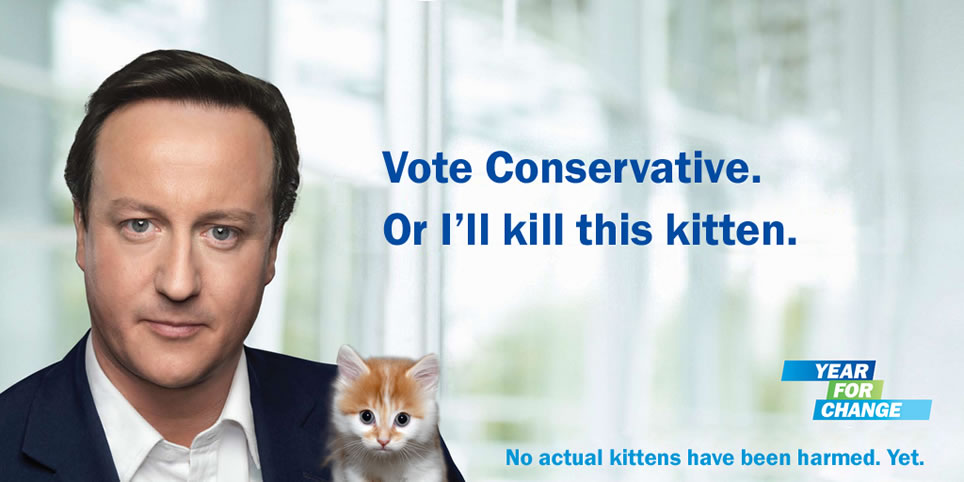
Oh, and don't get me wrong, while the 'Good' is having another option, in the UK election represented by Nick Clegg's Lib Dems, the 'Bad' is same old Brown and New Labour, the 'Ugly' is definitely Cameron and a return to Conservative rule. His botoxed smoothness may cover his forehead wrinkles but you don't have to look too far under the surface to see the same old Tory hate. While Clegg's 'earned route to citizenship' plan doesn't sound like a panacea to the UK's immigration problem and Brown's Bigot-gate has provided cover for Cameron, the Conservatives will surely speed the draconian slide of the country toward Arizona status. When branded anti-European and called out on his party's European Parliament alliances with fascists in Latvia, gay elephant (and non-elephant) bashers in Poland and ex-Czech Prime Ministers who party with Berlusconi... naked...with 17 year olds, David Cameron defended his alliance at the 35:35 mark of the 2nd debate: "One of our main allies is the party of the Polish president who tragically died in that accident who both of the politicians standing next to me praised as a great patriot and great statesman so I think we can hear no more of that." So, because Brown and Clegg paid their respects to someone who died in a horrible plane crash we're not allowed to question the friends he chooses to keep in Europe. Gotchya. Seems Schopenhauer was right, martyrdom is the only way a man can become famous without ability.

You don't need the TV to be repulsed by Cameron's party's policies, unless you like class war that is. We know the Tories do, for as Warren Buffet put it "There’s class warfare, all right, but it’s my class, the rich class, that’s making war, and we’re winning." David's blue-blood (seriously, he's a direct descendant of King William IV while his wife's clan came via King Charles II) his Eton education, and his party's monied membership would like nothing more than to increase their share of the pie all the while trying to convince us that they're just like us. He will give a £1.2 billion inheritance tax cut to the richest 2% in Britain, with the benefits going to the 3,000 wealthiest estates worth more than £2 million (including his wife's). Then he promises to end the 50% top rate of tax, giving another £2.4 billion to the richest 1%. Furthermore, he has pledged to cut taxes on the pensions of the richest, handing another £3.2 billion to the same folks. Adding insult to injury, his marriage tax relief policies will give 13 times more to the rich than the poor. To pay for this, he will slash programmes for the middle and the poor, like the Child Trust Fund, SureStart and state schools.

Paradoxically, Brown, leader of the party who led his nation into its unholy alliance with finance, was favoured to win the final TV debate that was to focus on the economy. Despite being the Chancellor of the Exchequer who was the financial architect of the New Labour party that helped destroy the financial world, he's still trying to convince the voters that he is the man to navigate today's rocky economic waters. Sure, we can blame the banks, after all they did purposely set people's homes on fire by packaging loans in such a way that they'd fail, then sold them to the investing public while taking short positions in order to profit when the securities crashed. They bet against our cities and states instead of performing the socially beneficial role of capital allocation. Today's financial markets rent seeking behavior more often than not leads them to destroy value. The banks insatiable appetite has grown to country-sized proportions, and with the UK's debt rivaling that of Greece, there's no guarantee that having maintained the pound will serve as a defense once the PIGS have been consumed.

In case you missed it, while the world has been focusing on those PIGS, the CDS spreads (Credit Default Swaps - hedge bets to protect holders of debt in case of default) have been widening on UK debt, outpacing even Spain, signalling the market's loss of confidence in their ability to repay their debt. No wonder, the UK's deficit for calender 2009 hit £159.2 billion, 11.5% of GDP, a figure higher than Spain and Portugal. Sovereign defaults usually occur after a frenzied run up in debt, on average a 40% increase over four years, coincidentally the exact amount estimated for Greece between 2007 and 2011. Meanwhile, Britain's debt will increase by 44% over the same period. A Conservative win will put Cameron's Bullingdon Club buddy George Osborne in charge of the economy, just what the country needs at a time of crisis. Somewhat surprisingly for those who still write-off the Lib Dems as short on policy, in a debate between the aspiring Chancellors of the Exchequers, Lib Dem Vince Cable outperformed both the incumbent Alistair Darling and the Shallow Chancellor, George Osborne.

Both Clegg and Cameron picked up on the populist anti-bank meme in their final debate, referring to them as casinos, yet, the worst actor of all in this saga has been the governments. The Conservative leader got it right, saying at the 29:48 mark, "if you look at the Labour record over the last 13 years, they did very much hitch the fortunes of the economy to the city of London. And we got in a situation where we ended up with the whole economy having to serve the banks rather than the other way around." Fortunately, Clegg reminded the viewers at 30:51 that "both Conservative and Labour governments now for ages have been far too close to the City, basically preferring the interests of one square mile of the city of London rather than 100,000 square miles of the United Kingdom." No matter how much the Conservative spin doctors try to hide it, Cameron and his team are the broken system. A system that has been rigged by the people in charge, it's not regulation that's bad, it's the neoliberal policy of global capitalism through government/military interventionism to protect the interests of multinational corporations.

Regulatory capture was invented by the railroads but perfected by the financial industry. A financial world of capitalism without capital was enabled by Wall Street's friendly takeover of the US Treasury; Regan came from Merrill Lynch to be followed by the likes of Robert Rubin, Lawrence Summers, Henry Paulson and little Timmy Geithner, men who have made immense fortunes thanks to the rules they helped create. Brown's Labour promises to maintain the status quo and Cameron's Conservative plan to further enrich the banks don't address the problem. When RBS failed in 2008, it had a balance sheet worth roughly 1.5 times the UK economy, do we really want to see what happens when even bigger banks fail? Yet even today, the plutocrats are aware that we still have the power to change the system. Smaller states have to fall in line or face regime change, but for the first time in a long time, the British electorate have the opportunity to attain change through the ballot box. First they ignore us, then they laugh at us, then they fight us. Then we win.

All this makes the UK's May 6th election actually matter. Not in the fake American lackey kinda way in order to "punch above its weight" on the international stage, but in the real change the world kind. With a mid-term election coming up in the US, perhaps a UK upset result could somehow manage to get a bit of press coverage, doubtful I know, but I can dream. Without some kind of wake up call, the world will continue to be subjected to a system that it has lost confidence in, slaving away to maintain your bank credit rating while paying taxes to support their socialized system of profit and loss. Here in Poland, the voter is basically given the same no choice, a fundamentalist PiS or corporatist PO. In Hungary we've just seen a dramatic gain in parliamentary elections for the neo-fascist Jobbik party while Greece has forced the world to chip in to maintain their debt payments to those banks. What the UK and world need is not more of the same; a new way of seeing things is needed to tackle the growing threats of climate change, terrorism, oil dependency, overpopulation, resource depletion, access to clean water and TBTF banks with their global reach and implications. Choice disappeared when Tony Blair and Bill Clinton entered 10 Downing Street and 1600 Pennsylvania Avenue respectively, it's time to break loose from the straight jacket. Who knows how it'll all turn out, who even knows if Clegg will even bring any change, but it's worth finding out, there's still time. After all the UK still isn't in quite the state of the States, but they certainly have been trying their best.

The Daily Show With Jon StewartMon - Thurs 11p / 10c
United Kingdom General Election
www.thedailyshow.com
Daily Show Full EpisodesPolitical HumorTea Party